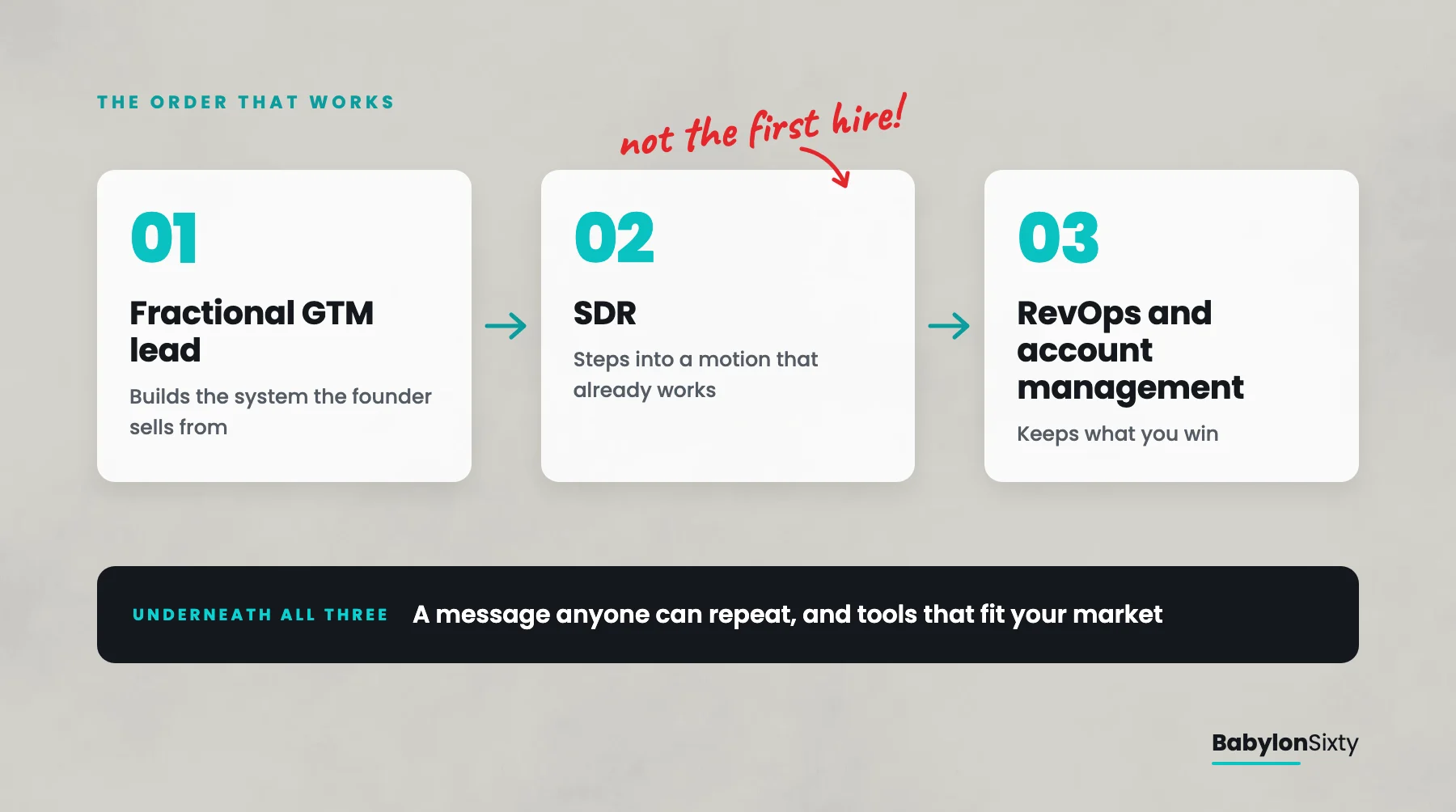
Most founders make their first go-to-market hire the same way. Pipeline is thin, the founder or the CTO is doing all the selling, and the obvious answer is to hire an SDR. Six months on, that SDR has spent most of their time building lists, guessing at messaging and wiring up tools nobody asked for. Then they leave, and the whole thing resets to zero.
The order of those first three hires matters more than the calibre of any one of them. Two things sit underneath the order and get skipped: the message, and whether the tools fit the business you actually run.
The founder-led sales trap
Every early-stage business sells through its founder. In SaaS it is often the CTO, because the first customers bought the idea and wanted to talk to the person building it. That works for the first fifteen logos.
Then it stops. The CEO or CTO still carrying the pipeline at customer thirty is the constraint on the whole company, and none of what they know is written down. The qualification instinct, the objection handling, the way they explain the thing in the first four minutes all live in one head, and none of it survives that person taking a week off.
There is a second problem, and it is easy to miss. Your beta customers and co-creation partners did not buy the way the rest of the market will. They bought the founder and the chance to shape something. Past that group, you are selling to people with no stake in your story and no patience for a product tour.
The early days are meant to be messy
None of this is a criticism of how the first year runs. The early days are messy by design.
There are no systems. The CRM is a spreadsheet, or three spreadsheets, or the founder's inbox. The narrative changes in every conversation because each one teaches you something, and the version you gave on Tuesday was genuinely worse than the one you gave on Thursday. Brand design sits a long way down the list, because a logo does not close a deal when you have four weeks of runway and a customer who needs a demo tomorrow.
That phase is about scraping and winning ugly. Take the deal slightly outside the profile, build the feature asked for on the call, say yes to the pilot that barely pays. You are buying information and survival, and both beat tidiness.
None of it is a system, though. It is a series of one-offs that happened to work, held together by one or two people who remember why.
General availability changes the maths. The moment you are selling to a market, and no longer to a handpicked group, the mess stops being an asset and starts being the thing that caps you. You cannot onboard a salesperson into a story that changes weekly, forecast off deals that were all won differently, or hand over a customer whose whole relationship lives in the founder's head.
Structure is what lets the company keep the wins once they have to be repeatable.
The message is the first piece of infrastructure
Tools and people matter. Neither compensates for a story nobody can repeat.
Beyond the beta group, you have to sell the why as hard as the what and the how. The why is the only part a buyer can carry into a room you are not in.
A workable narrative does five things. It names a change in your buyer's world that would be true even if your company did not exist. It shows there are winners and losers, with an old mindset as the enemy and never a named competitor. It paints the destination so well that stripping your product name out still leaves something compelling. It introduces what you do as the thing that clears one obstacle on the way there. And it proves the point with a customer like them who has already made the journey.
Write this before you hire anyone. It is the brief the GTM lead builds to, the script the SDR ramps on, and the reason the RevOps hire can tell a stalled deal from a dead one. Skip it and every tool in your stack faithfully scales the wrong message.
Hire one is a fractional GTM lead
The job is to build the system the founder sells from, and to get the founder out of being the only person who can sell.
That means the ICP model and addressable market, the signals that say who is in market now, the narrative, the sequences and a CRM structured around the stages you actually use. It also means coaching: turning what lives in the founder's head into discovery questions, qualification criteria and a repeatable first conversation.
This is the strongest case for a fractional appointment in the sequence. The work is senior, finite, and does not need forty hours a week. You want someone who has built the motion several times, embedded two or three days a week for six to nine months, with the job of making themselves unnecessary.
Hire two is an SDR. When they arrive the system is live. Lists running, sequences built, message settled. They step into a motion already producing signal and turn it into booked meetings. That is the difference between an SDR who ramps in 30 days and one who churns in 90.
Hire three is RevOps with real account management strength. Once pipeline is real, the cracks in the handoffs become impossible to ignore. This role builds the accountability layer: CRM decision logic, reactivation, champion tracking, forecasting. Give it account management capability too, because by then you have a customer base, and retention is cheaper revenue than anything the top of the funnel produces.
Where this is heading
Three hires is a phase, not a finished team, and the sequence only makes sense when you can see the destination. The mature version looks like five people: a GTM engineer, a content engineer, a senior SDR, a junior SDR and an AE. The diagram below sets out what each owns and the tools that arrive with them.
Five people now cover what took twenty a few years ago, because most of the manual work has been automated or assisted. That makes it tempting to hire the shape of that team before the business can feed it.
The phases matter more than the org chart, and two of them are worth saying out loud.
Phase three, once pipeline is predictable. RevOps with account management strength owns forecasting, reactivation and the customer base. The founder's involvement in individual deals should be visibly declining by now. If it is not, the problem is upstream.
Phase four, when there is more demand than the SDR can work. The AE arrives and the founder stops closing. This is the hire that most genuinely changes a founder's week.
Each phase earns the next. The trigger to move is always a measured constraint, never a funding round or a plan on a slide. If the SDR has capacity, do not hire an AE. If nobody is working inbound, do not hire someone to create more of it.
The tools have to fit the business you run
Most published GTM stacks run to thirty products and assume high-volume outbound into a large market, where the constraint is finding thousands of contacts. A New Zealand business selling into 400 accounts the founder could mostly name has a different constraint. Its bottleneck is relevance, so a five-tool enrichment chain solves a problem it does not have and adds a maintenance burden nobody owns.
Before any tool goes on the card, ask five questions. Which stage of the funnel is it for, and what measured problem does it fix? Does it fit the motion? Does it fit the market size? Who owns it after setup? Does it write cleanly into the CRM?
Run those across a thirty-tool stack and a small company usually lands on five: a CRM, one sequencing tool, one contact data source, an email verifier and an AI assistant. The money saved goes into the hire who builds the system.
The stack grows the same way the team does. Two tools sit across every role from day one, a CRM and an AI assistant, and everything else arrives with the person accountable for running it. Buy the dialler or the design suite before those people exist and you have paid for capability nobody owns.
Here is the whole thing on one chart: the hires, the tools that arrive with them, and the founder stepping back as customers grow.
Start with who you sell to
Build the message, then the system, then hire the people to run it, and choose the tools that serve that design and nothing more.
All of it rests on knowing exactly who you sell to. A vertical is not enough, and neither is a job title. You need a named group of customers who share a problem, a way of operating and a reason to buy now. Get that wrong and the narrative lands on nobody, the SDR works the wrong list, and every phase that follows scales the error.
If you want a second pair of eyes on the order, the message or the stack, that is the work I do.