
"Marketing's leads are cr*p."
"Sales can't convert."
"The customer just wasn't interested."
I've heard every one of these in a leadership meeting, and I've probably said a couple myself. Each one arrives with total confidence and very little evidence. It's a hunch, and hunches are cheap. The fixes that follow them are expensive, because they usually land in the wrong place.
Over the years, leading product and marketing teams, I've seen every stage of the funnel work well and every stage fail. The pattern that repeats is simple. The team points at the stage that hurts most, and the real cause sits somewhere else, often a stage earlier.
A recent assessment shows how easily the hunch misleads.
Recently I helped a B2B business look closely at a funnel that was frustrating everyone. On paper it looked like a classic middle-of-the-funnel problem.
The team's read was that sales wasn't converting. From the headline numbers, that was a fair conclusion.
When we pulled the funnel apart, the story changed. Leads were entering at the top on broad keyword matches, and there was no written definition of a qualified lead yet. Without a fit check before the handover, sales was qualifying live in the first meeting, and specialists were joining early calls to help work out the fit. That's expensive time. Many of the conversations that stalled were never the right fit to begin with.
The sales team was doing good work with what it was given. The leak was at the top.
Some funnel problems start before the funnel does.
Before blaming any stage, it's worth asking two uncomfortable questions.
The first is product market fit. Is the offer built on real customer insight, and does it solve a problem people will pay to fix? Or is it a solution looking for a problem? This needs answering well before a new product or feature reaches the market, and the accountability sits with Product. No amount of campaign optimisation rescues an offer nobody needs.
The second is translation. Does the go-to-market match the offer, and does the message land with the people it's aimed at? This usually gets filed as a marketing issue, and it runs deeper. Translating a product into a proposition customers understand is a skill in its own right. A weak brief from Product will almost always produce a weak go-to-market, however talented the marketing team.
So let's assume both are in good shape. The fit is real and the brief was great. Now the question is how the funnel itself operates, and how clear the process is.
Every stage needs a definition everyone agrees on.
This is where the jargon arrives. A lead. An MQL, or marketing qualified lead (what's one of those, I hear you say). An SQL, a sales qualified lead (you guessed it). Then opportunities, proposals and wins.
The labels matter less than the agreement behind them. Most B2B funnels break into three phases.
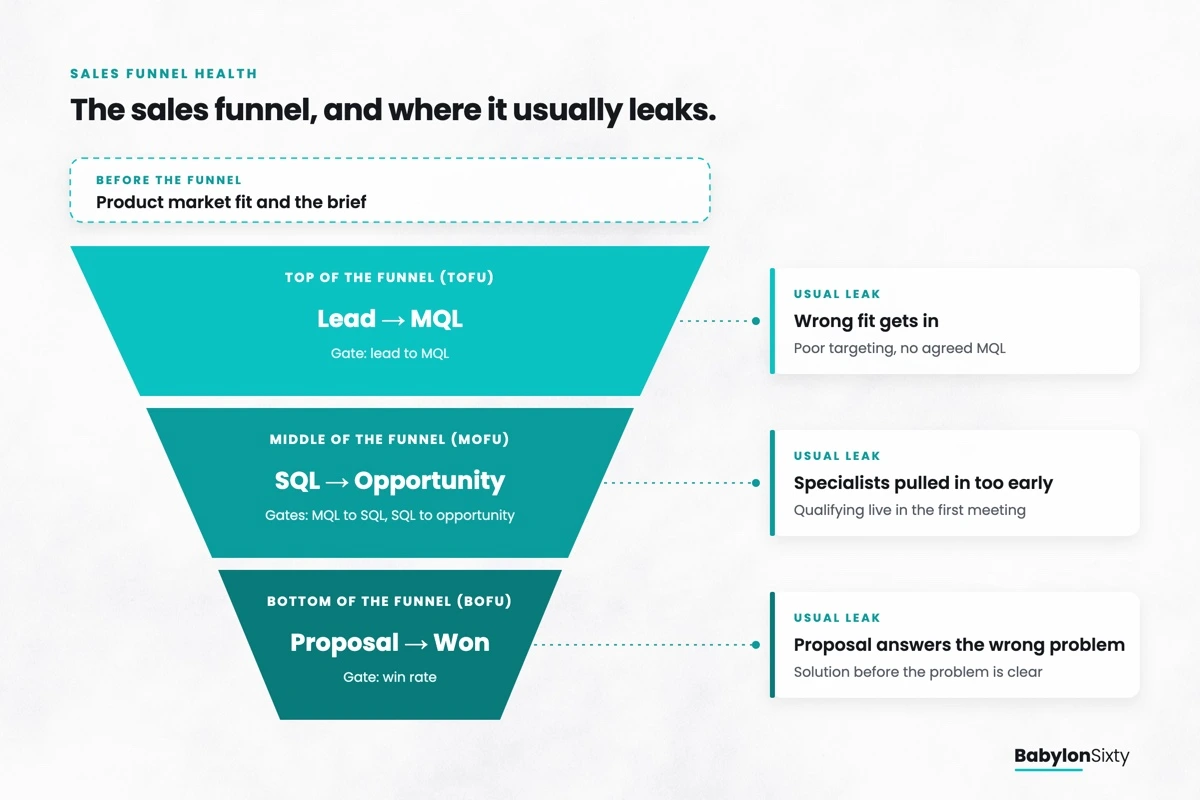
- Top of the funnel (TOFU). Leads arrive and get checked against who you sell to. The gate is lead to MQL.
- Middle of the funnel (MOFU). Sales confirms a real problem, a fit and a reason to act. The gates are MQL to SQL, then SQL to opportunity.
- Bottom of the funnel (BOFU). A qualified opportunity becomes a proposal and, with good process, a win.
Every organisation sets its own criteria for moving a lead from one stage to the next. When those criteria are vague, unwritten or owned by nobody, the funnel leaks at the gates, and each team blames the one on the other side of the handover.
Where the leaks usually sit.
At the top. Leads that are poorly segmented, or aimed at the wrong problem, either qualify out early or, worse, fall through to a sales team who then have to sift them and qualify them out by hand. Volume looks healthy. Quality doesn't.
In the middle. Sales can't quite read the lead, so they bring technical or delivery people onto the first call. That's expensive resource, spent on conversations that were never going to close. A strong qualification process earns its keep here. Keep the early conversations on the customer's problem and resist jumping to the solution. The first solution is often the wrong one, and a proposal built around it tends to lose the deal.
At the bottom. Opportunities convert poorly because they were never truly qualified, the proposal answered a question the buyer didn't ask, or nobody knows why deals are lost because nobody asks.
Good practice is well documented and rarely followed.
None of this is new. The industry has had good answers for years.
- Write down your ideal customer profile, and use it. Salesforce puts the average MQL to SQL conversion rate across industries at around 13%, and Forrester's research on the revenue waterfall reports similar ranges. Teams with a tight, shared ICP do markedly better, often 20% or more.
- Agree the gates in writing. Marketing and sales share one definition of an MQL and an SQL, plus an agreement on who hands over what and how fast it gets followed up. Many teams call this a service level agreement.
- Qualify on the problem first. Frameworks such as BANT and MEDDICC exist for a reason. Pick one, keep it simple, and use it every time.
- Measure every gate. You can't find a leak you don't measure. Track conversion at each stage, time in stage, and the reason every lost deal was lost.
- Close the loop. What sales learns in first meetings should flow back into targeting and messaging every month.
The do's and don'ts I'd pin to the wall.
Do
- Write down who you sell to and the problem you solve.
- Define every stage, and who decides a lead has passed it.
- Keep first conversations on the customer's problem.
- Record why deals are lost, and count the wrong-fit ones.
- Test your hunch against the numbers before you act on it.
Don't
- Hand every lead straight to sales.
- Bring specialists onto calls before a lead is qualified.
- Write the proposal before you understand the problem.
- Judge the funnel on lead volume alone.
- Blame the stage that hurts most without checking the one before it.
Five steps to a healthier funnel.
- Check the foundations. Confirm the offer solves a real problem and the brief from Product gave marketing what it needed. Everything downstream inherits these, so fix them first.
- Define the gates. Write down what a lead, an MQL, an SQL and an opportunity mean in your business, and who decides at each gate.
- Measure the last 90 days. Pull the numbers for each gate over the last quarter. Estimates are fine to start with. Every "don't know" is a finding in its own right.
- Find the real leak. Compare your numbers with benchmark ranges and with your hunch. Look hard at wrong-fit losses and at how much senior time goes into unqualified calls.
- Fix one gate at a time. Start with the earliest leak, change one thing, measure again next month, and keep what works.
Start with your own numbers.
If you're reading this with a hunch about where your funnel leaks, test it. I built a free Sales Funnel Health Check that takes about three minutes: ten questions, estimates welcome, and "don't know" counts as an answer. You get a Funnel Health Score, your funnel drawn against indicative B2B ranges, and a plain-English read on whether the leak sits at the top, the middle or the bottom. It also tells you whether your hunch was right.
Take the Sales Funnel Health Check
I'd love to hear how your hunch compared with the numbers. Tell me on LinkedIn.