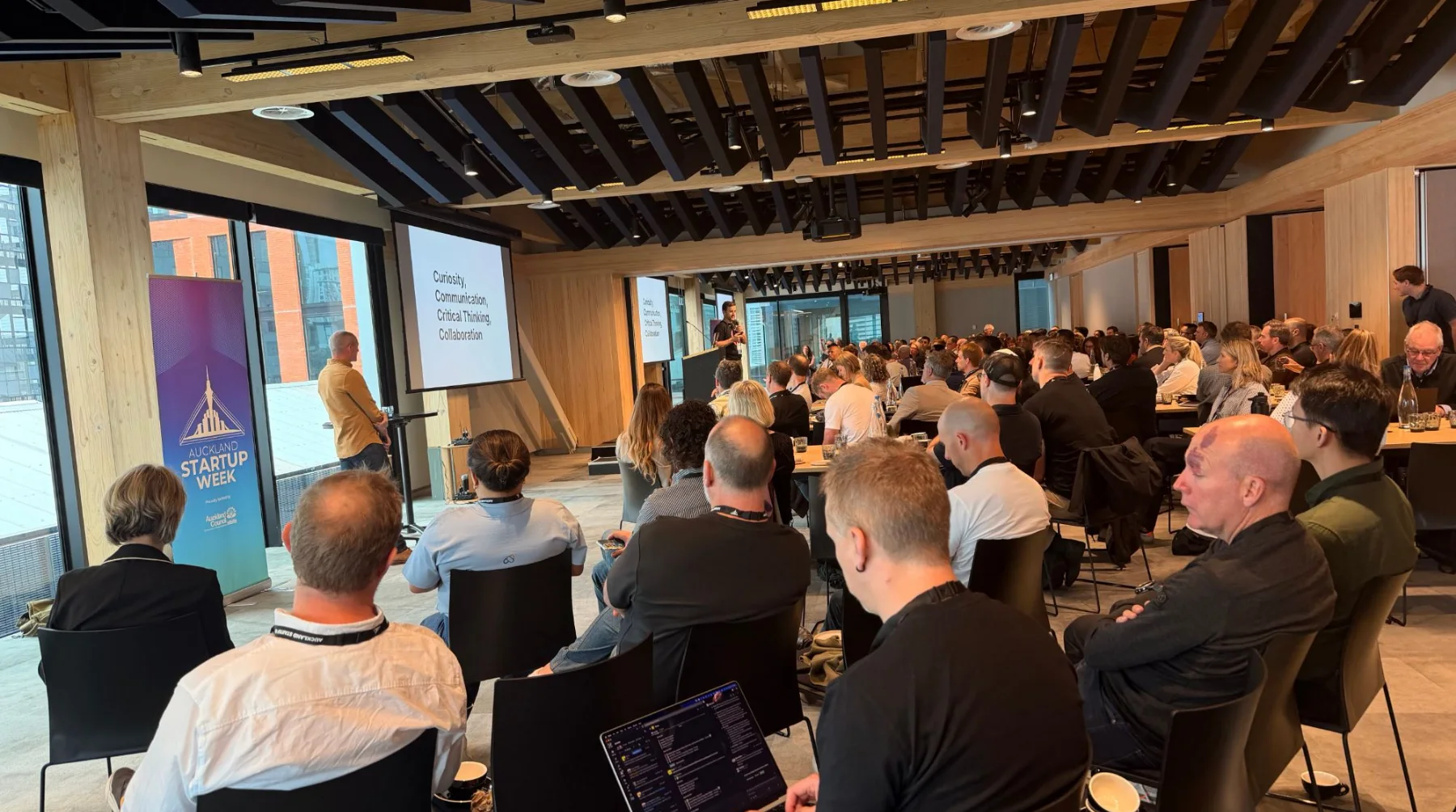
The session was billed as SaaSpocalypse Now and turned into a case for people
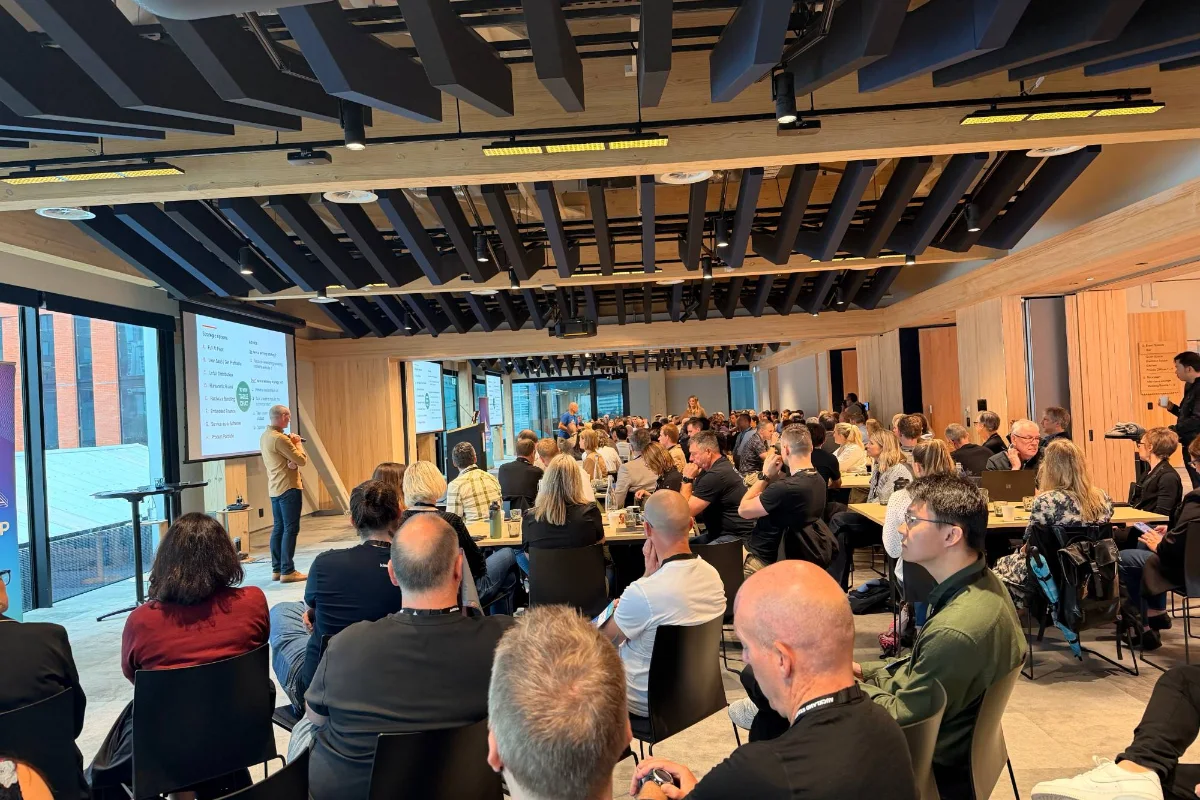
As Auckland Startup Week neared its conclusion, a session called SaaSpocalypse Now undersold with its title what was actually said in the room. David Clearwater, executive director at KiwiSaaS, hosted alongside Serge van Dam, director at Re-Leased, Cogo and Tapi. Jenae Turner, head of people at Ideally, Charlie Marsh, sales and growth leader at Tradify, and Simon Young, CTO at Serko, joined as guest speakers.
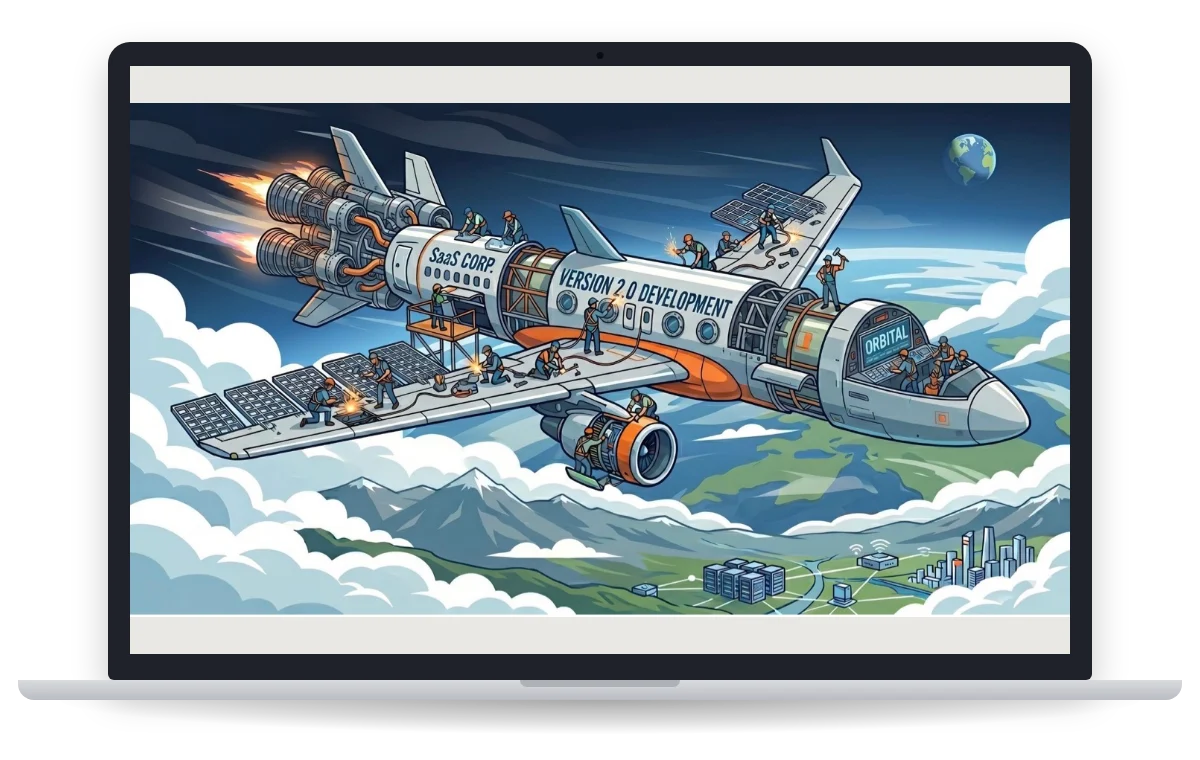
The conversation was about the impact AI is having across SaaS start-ups, with a focus on marketing, product, go-to-market and people, and every thread led back to the same question. If AI can now do a large share of the work, what is the human still for? The answer that emerged was consistent and, for anyone building a career or a company in software, encouraging.
AI is being included in almost everything product and marketing teams do. The organisations that will get the most from it are the ones that work out where the human belongs in the process and protect that place deliberately.
Four skills will stay in demand whatever the tools do
The clearest insight of the day was about people. Whether you are a product manager, an engineer, a designer or a product owner, four skills will remain in high demand regardless of how far AI goes:
- An abundance of curiosity
- Great communication
- Critical thinking
- The ability to collaborate
Everything else is secondary. Technical skills will keep shifting as the tooling shifts, and a stack that looks essential this year may be commoditised the next. These four do not depreciate. If anything, they become more valuable as AI takes on more of the execution, because they are the skills that decide what to build, whether the output is right, and whether a team can act on it together.
A model can produce fluent, plausible work on demand. It cannot ask the question nobody in the room thought to ask, notice that a confident answer is wrong, explain a trade-off to a sceptical stakeholder, or hold a team together through a hard decision. Those are the jobs that remain, and they are the jobs that have always mattered most.
The new capacity belongs at the front of the value chain
AI is creating enormous capacity inside product and engineering teams, and the easy mistake is to spend it on volume. More features, shipped faster, is the default outcome if nobody decides otherwise. It is also the least valuable use of the abundance.
The better move is to push that capacity forward in the value chain, into discovery and ideation. Time freed from execution should go to sitting with customers, understanding the problem properly, and working out which features are actually required before anything is built. A team that can build three times as much needs to be three times as sure it is building the right thing.
This is where the four skills show up in practice. Curiosity drives the discovery. Critical thinking filters what the customer says from what the customer needs. Communication and collaboration turn that understanding into something the whole team can act on.
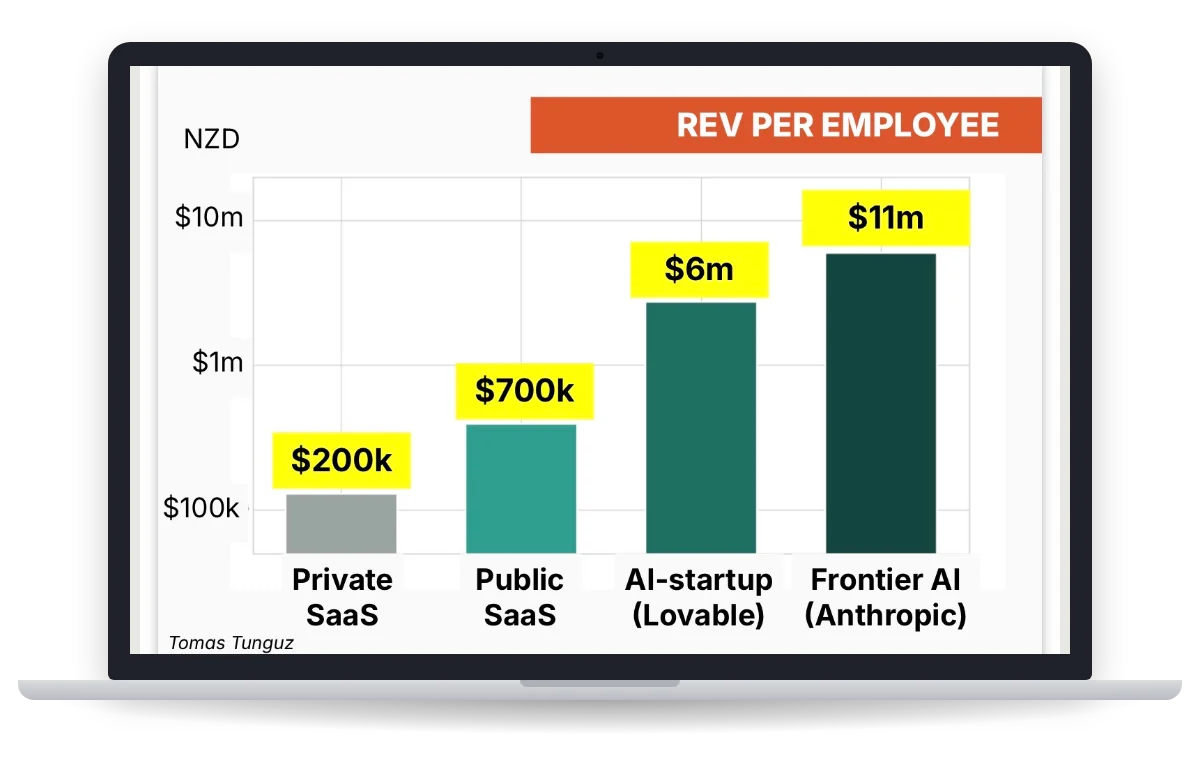
David Clearwater showed one chart that made the scale of the shift plain: revenue per employee by the type of organisation. A private SaaS business sits around NZD 200k per head and a public one around 700k. Lovable, an AI-first SaaS business, is near 6 million, and a frontier AI company near 11 million. His point was that AI, and a business built on it as its foundation, is where the value is being created.
Product management is a function, and it is moving toward the customer
Simon Young, CTO at Serko, made a point in his talk that stayed with me. The hard stuff is not that hard any more, because AI is lending a hand with it. What has not changed, and if anything matters more, is product management.
I would go a step further. Product management is a function. It does not have to be one person's job. As technical skills become more transferable and easier to pick up, and we are all developers now, the product manager's focus shifts toward the customer, which is where I have always argued it belongs.
Simon named four things that define the function from here, and I agree with every one of them: a deep understanding of your customers and the market, deciding what to build and what to leave unbuilt, aligning the team around why the work matters, and learning from what happens once the work is done.
Those four map almost exactly onto the four skills. Curiosity for the understanding, critical thinking for the prioritising, communication for the alignment, and collaboration for the learning.
Nobody has the playbook yet, and small curious teams will write it first
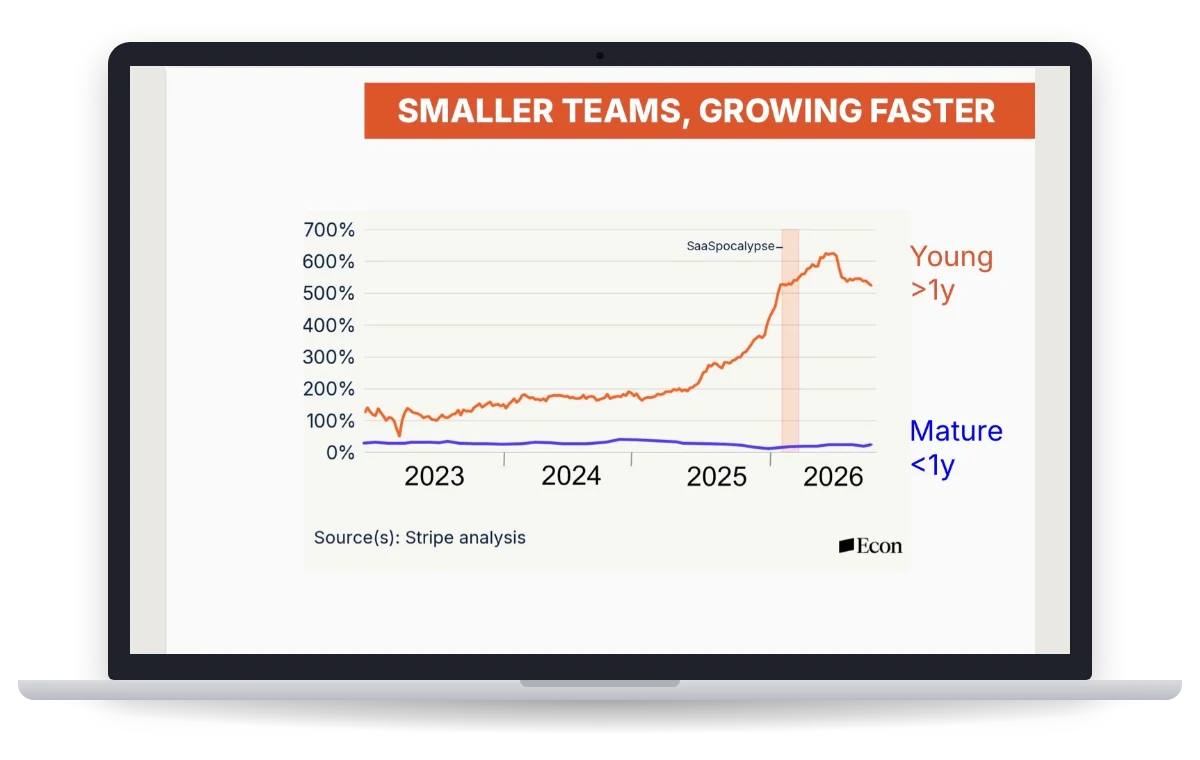
From a leadership perspective, the picture is wide adoption and shallow mastery. A large share of organisations say they are using AI or experimenting with it. Far fewer are doing it well. The organisations doing it well are doing it with smaller teams, four to six people, which keeps velocity high while still holding enough varied thinking to challenge an answer before it ships. The honest position in the room was that nobody has a settled playbook for how teams should operate in this environment, and that one will have to be worked out through continual involvement. There is no manual to read it from.
My own takeout, wearing the fractional CMO and CPO hat, is that small, nimble and curious teams will do well in this world. The ability to take calculated risks matters more than it did. A team small enough to ideate and solve problems quickly, and willing to put a prototype or an early-phase product in front of customers to validate its thinking, will learn faster than a larger team waiting for certainty. That is where the acceleration will come from.
Shortening the learning loop changes how teams behave
One slide captured the shift in three moves. The lagging approach seeks certainty, perfects the answer, then rolls out the solution phase by phase. Learning is slow because every cycle is long. The leading approach tries something, shares the learning, and adjusts quickly. Same three moves, a far shorter loop.
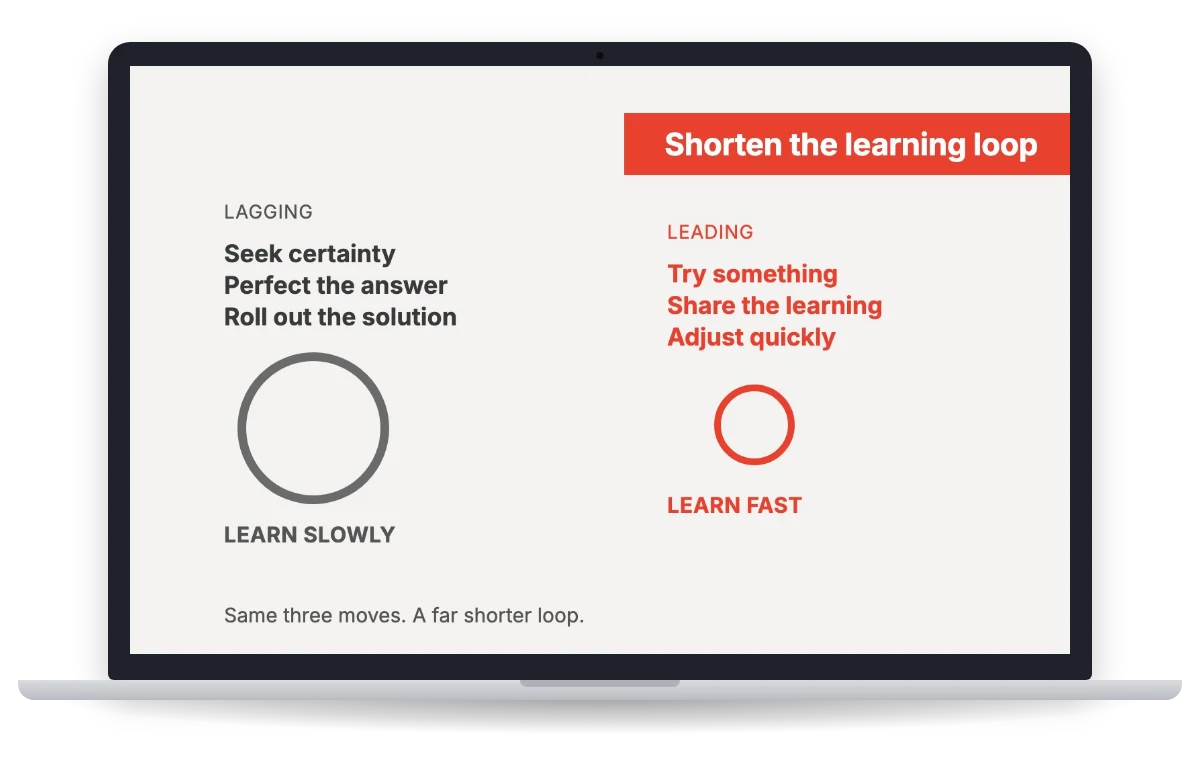
AI makes the short loop affordable. Research that took a week takes an afternoon. Testing that needed a dedicated sprint runs alongside the build. The cost of being wrong falls, so the willingness to try rises.
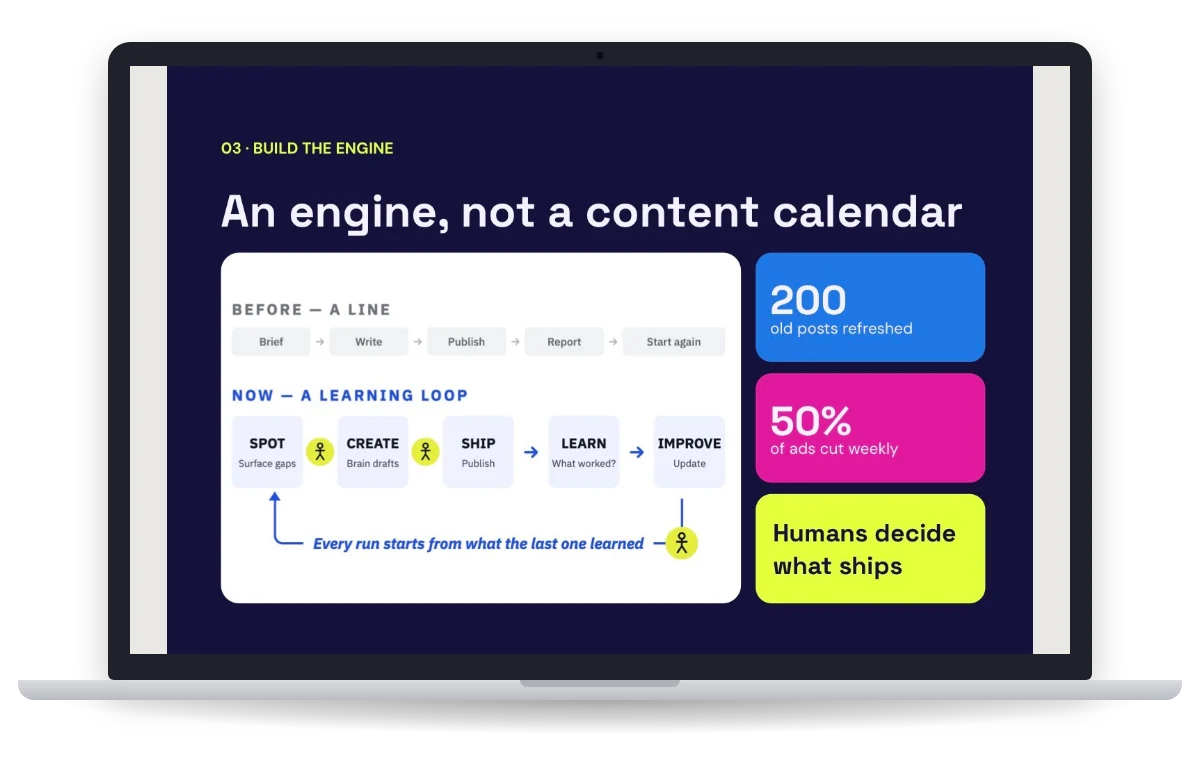
Documentation is a good worked example. As a product manager, one of the hardest things to extract from a team was the documentation that should accompany the product. It was always done at the end, under duress, by whoever drew the short straw. With AI agents in the build, documentation can be designed and co-created in parallel with the product itself. The mundane task gets absorbed into the flow, and the human attention it used to consume is freed for work that needs judgement.
The short loop has drawbacks too, and the session was honest about them. Fast learning only works if someone is still asking whether the learning is correct. A team that ships, measures and adjusts at speed without critical thinking in the loop is just making mistakes faster.
Velocity has a human cost that leaders need to design for
AI is making teams more efficient and probably more effective. It is also contributing to burnout. Jenae Turner's work at Ideally sits right on this tension, building structures that help employees sustain the new pace without breaking.
The AI era brings more context switching, more information, and more cognitive load. Turner's observation was that the load itself is not the main cause of stress. The missing piece is decompression time afterwards. People can hold a high cadence for a period, but the brain needs time to recharge before it can go again.
Jim Loehr put it well: "The real enemy of high performance is not stress. The problem is the absence of disciplined, intermittent recovery."
Ideally is looking at mechanisms that build that recharge into the cycle, so velocity is maintained for a defined stretch and then deliberately released. This is a leadership design problem, and it is one most organisations have not yet recognised. If AI lets a team run faster, the people leading that team have to decide when it stops.
Buyers want AI for discovery and a human for the decision
The go-to-market discussion followed the same pattern. There are now far more tools driving prospecting, with Apollo, Artisan and Clay making outreach more efficient and more effective, and AI SDRs helping sales teams cover more ground.
Then came the question that split the room. Asked whether they would prefer to be sold to by AI or a human, most hands went up for the human. Asked in the next breath who they would rather have lead a product demo, the majority chose the machine.
My view is that it depends entirely on where the buyer is in the process. There is nothing worse than signing up to a SaaS product for a bit of research and being inundated with calls and emails pushing a demo while you are still in discovery. At that stage an AI-led demo or a machine-driven user guide is exactly what you want. The human earns their place later, when you are ready to purchase and want the finer detail, when there is nuance in the commercials, or when the product is really a service with a non-commoditised element behind it. That is when you want to talk to the organisation and the people behind it.
The lesson for SaaS teams is to map the human to the moment. Automate the early funnel and let buyers self-serve their way to understanding. Then put a person in the room at precisely the point where judgement, trust and negotiation decide the outcome.
Do not let AI be the only voice in the room
I say this to clients whenever the conversation turns to using AI to streamline or fast-track a process. Make sure there is still a human element inside the process itself, and do not let AI be the only voice in the room. That principle ran through everything discussed at the session.
AI can accelerate the work. It can streamline the research and run the testing. What it cannot do is the critical thinking that decides which questions are worth asking and whether the answers hold up. That remains inherently human, and it is the part of the process where most of the value is created or lost.
The task for every organisation is balance. Put humans where judgement, context and trust are required, and use AI to absorb the mundane tasks that used to consume their attention. Inclusion of AI is no longer optional for a competitive product or marketing team. Inclusion of the human has to be just as deliberate, or the speed gained on one side will be spent on mistakes on the other.
New Zealand SaaS is alive and well, and this is where the growth has to come from
The SaaSpocalypse never arrived. The film the title plays on sends a man upriver to find the thing everyone fears, and what he finds at the end is a man. The session went the same way. It went looking for the end of SaaS and found people: a New Zealand SaaS community that is adopting AI quickly, thinking seriously about its effect on people, and still finding its footing on how to lead through it. That is a healthy position to be in.
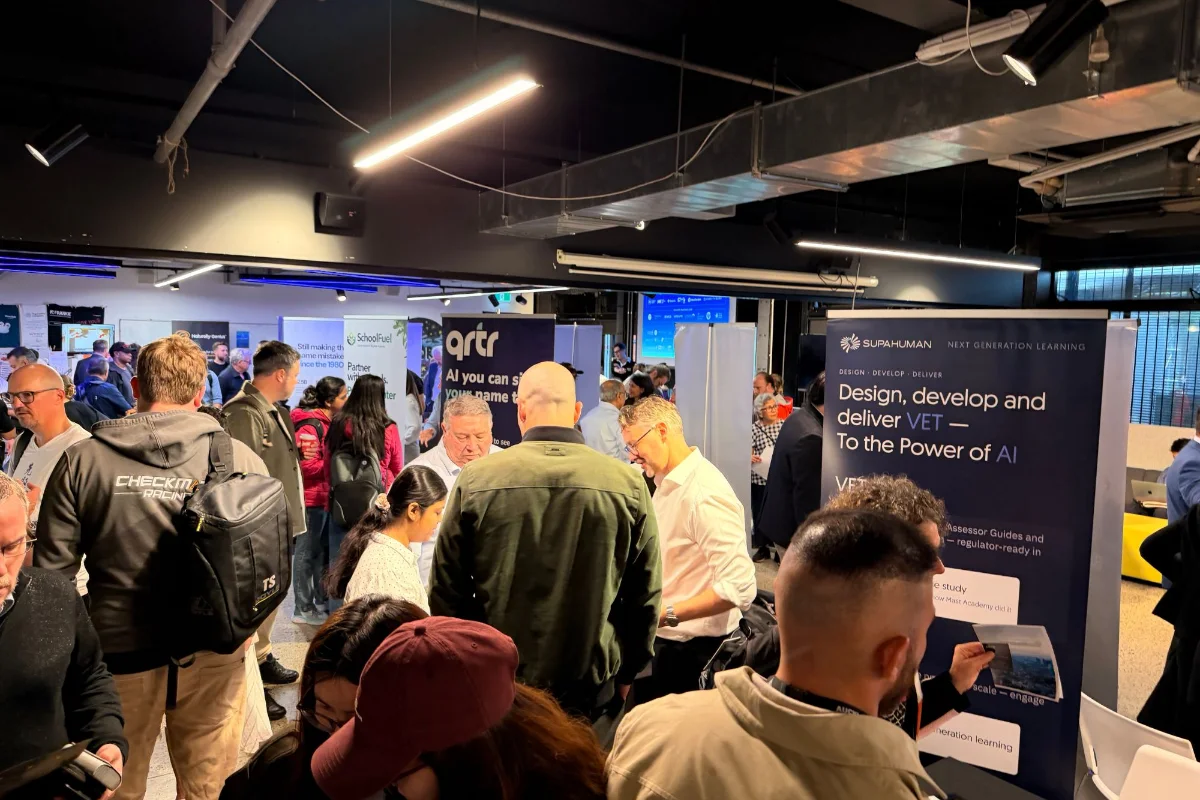
It is also an export opportunity. We have the skills and the expertise, and software travels across borders in a way most of our traditional exports cannot. Guy Haddleton, the serial entrepreneur and investor, NZ Rich Lister and Flying Kiwi, has been arguing in recent interviews that New Zealand has to make more, grow more and export more value if the country's wealth is going to grow, and that software is where it can happen fastest. He is right. We need to be doing more of it, faster, better and at greater scale.
The companies that get there will be the ones that include AI in everything and still put a curious, communicative, critical and collaborative human at the centre of it. The tools are the easy part. The future is bright for the people who bring the four skills.
If you want to talk about where the human belongs in your product or marketing process, that is the work I do.