In one of my previous articles, I covered the first three go-to-market hires. This one is about the work itself, because the work has an order too, and most teams run it backwards.
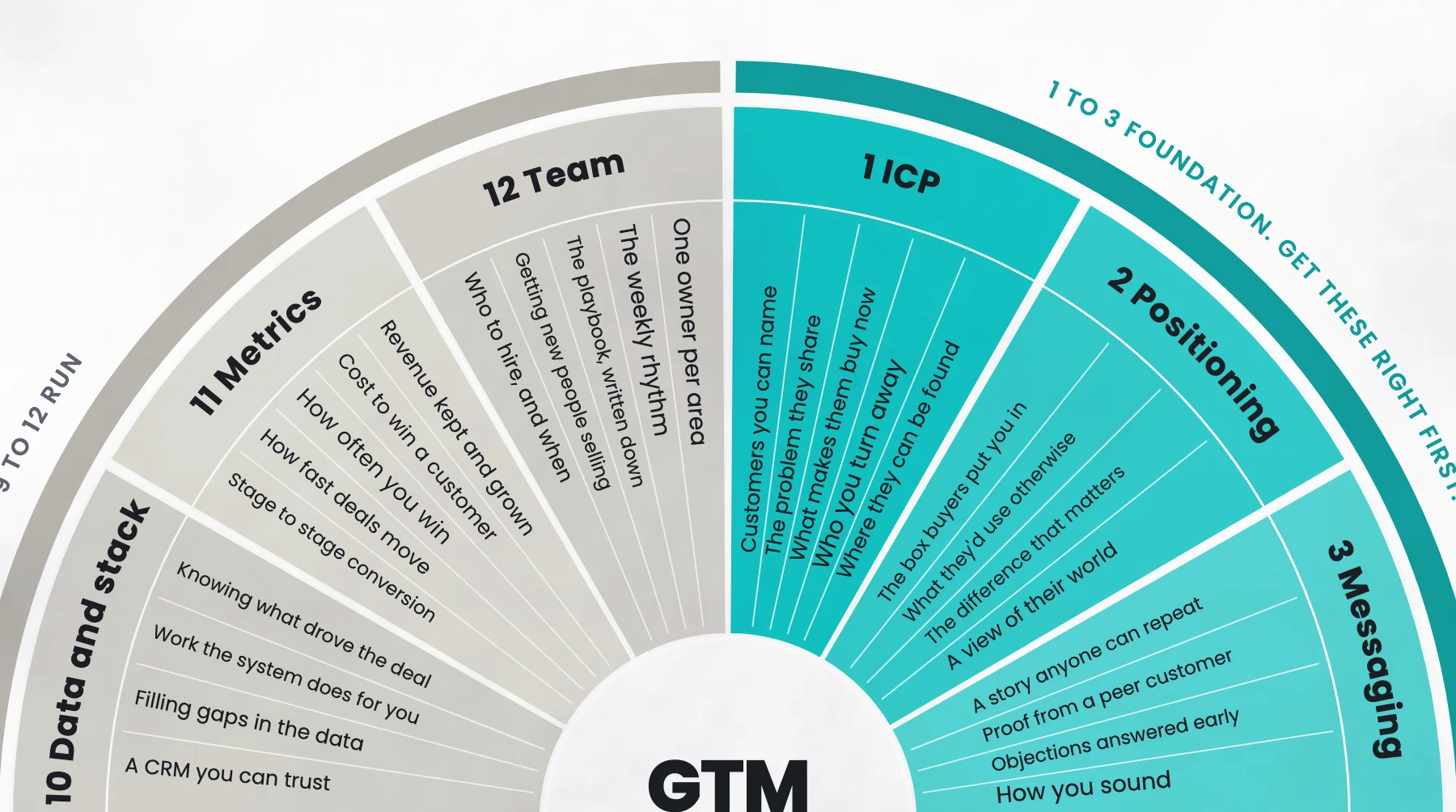
There are twelve areas to a working go-to-market. Most teams start with the visible ones: outbound sequences, a content calendar, a pricing page, a CRM. They are where the activity is, so they feel like progress.
Three areas sit underneath all of that. Who you sell to, where you stand, and what you say. Get those three right and the other nine get cheaper, faster and more likely to work the first time. Get them wrong and every one of the nine faithfully scales the mistake.
Twelve areas, one order
Here are the twelve in the order I work them with a client. The first three are the foundation, the next five build the motion on it, and the last four keep it running once customers arrive.
Every area on the wheel matters eventually. The order decides what each one costs.
What I keep seeing
Three recent engagements, names left out, show the same pattern.
One business with real technical depth had outbound running before anyone could say who the buyer was. The list was a job title in an industry, the reply rate said so, and the fix was to stop sending and write the profile.
A second had set its pricing and tiers before it had a position. The tiers described features, so every sales conversation became a comparison on price, because nothing else had been given a value.
A third had a messaging framework that could have belonged to any company in its category. It named no change in the buyer's world and no cost of standing still, so it was polite, accurate and ignored.
The pressure in each case was the same. Move quickly, show activity, get something into market. Skipping the first three areas felt fast. It had the opposite effect, because every week of activity pointed slightly wrong and nothing it produced could be reused. That is why I start every engagement with those three, and why I push clients to do the same.
Step one is who you sell to
An ideal customer profile is a named group of customers who share a problem, a way of operating and a reason to buy now. A vertical is too wide. A job title is too thin. The test is simple: could your sales and marketing people find these customers this afternoon, in the CRM, on LinkedIn, in a list they could build? If the answer is no, the profile is a slide, and slides do not generate pipeline.
The profile also tells you who to say no to, which is the part most teams skip and the part that saves the most money later.
Step two is where you stand
Positioning is the category the buyer puts you in, the alternative they would choose if you did not exist, and the one difference that matters to the customers in step one. It also carries a point of view about their world that would be true even if your company disappeared tomorrow.
Positioning written for everyone lands on no one. Written for a named profile, it almost writes itself, because the profile already said what those customers care about.
Step three is what you say
Messaging is the story anyone in the company can tell in four minutes. The change in the buyer's world, the cost of standing still, the destination, and your product as the thing that clears one obstacle on the way. Proof comes from a customer like them who has already made the journey, and the three objections you hear most are answered before they are raised.
Write it down. The version in the founder's head does not survive a week of leave.
Why the first three pay back ten times
Look at what the other nine take as input.
Pricing is a value metric for a known buyer. Content answers that buyer's questions in the founder's voice. Outbound is the message, sent to the list the profile defined. Sales is the same story told live. Partnerships are the people already selling to those customers. Onboarding delivers the promise the positioning made. The CRM fields mirror the profile's attributes. Metrics only mean something against a defined market. Every new hire ramps on a written story in weeks, where a verbal one takes months.
Each of the nine multiplies the first three. A sequencing tool sends a weak message to the wrong list at scale. A strong message to a named list needs far less of everything else.
That is where the ten times comes from. The foundation costs a few weeks of hard thinking. Skipping it costs a year of activity that cannot compound.
Start with step one
If you have a profile written down, test it. If you do not, the first question will tell you what is missing.
The ICP Findability Check takes about ten minutes. Paste in your ideal customer profile and it shows you whether sales and marketing could actually find those customers, and what to fix first.